

The roots of Ceibo Executive Coaching
“An organization cannot sustain extraordinary growth without deep, wide structural support underneath.”
About the Ceibo Tree
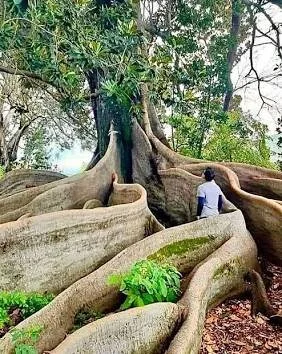
The Ceibo Tree (also known as the Ceiba pentandra or World Tree) is a towering giant of the neotropical rainforests. Known for its immense height, structural endurance, and expansive canopy, it functions as a complete self-sustaining ecosystem rather than just an isolated plant. In ancient traditions, it was viewed as the axis mundi—the structural central pillar linking the roots below, the trunk on the ground, and the canopy reaching toward the sky.
Beyond its basic anatomy, the Ceibo (Ceiba pentandra) holds remarkable ecological secrets, historical superpowers, and deep mythological significance.
1. Photosynthetic Bark: It Can Produce Energy Without Leaves
During dry seasons or periods of severe drought, the Ceibo drops its foliage to conserve water. However, unlike most trees that go entirely dormant, the young trunk and branches contain chlorophyll just beneath the outer bark layer, giving them a greenish hue. This allows the tree to continue photosynthesizing and generating energy even while completely leafless.
2. Nocturnal Flowering & "Bat Engine"
Ceibo flowers bloom almost exclusively at night, emitting a strong, pungent, musky odor and producing up to 10 liters of nectar per tree each night.
Because of this nocturnal cycle, the tree relies primarily on fruit bats and large night moths for pollination rather than daytime bees or birds. A single blooming Ceibo can attract hundreds of bats in a single night, acting as a critical fuel stop for night-migrating mammals across Neotropical forest corridors.
3. Historical Life Preservers: The Kapok Fiber Miracle
The fluffy white fiber found inside Ceibo seed pods is called kapok (or silk-cotton). Kapok fibers are hollow, lightweight, coated in a natural wax, and eight times lighter than cotton.
Buoyancy: Kapok fibers can support up to 30 times their own weight in water without sinking.
WWII Maritime History: Before synthetic materials existed, kapok was the primary stuffing used in life jackets, life preservers, and insulation for naval vessels during World War II.
4. Maya Cosmology: The Ya'axché (World Tree)
To the ancient Maya, the Ceibo was known as Ya'axché—the central pillar of creation (axis mundi):
The Roots: Deep in Xibalba (the underworld).
The Trunk: The earthly plane where humans reside (Kab).
The Canopy: Reaching into the 13 layers of the celestial heavens (Okhwa).
The Maya believed that souls of the departed climbed the trunk and branches of the Ceibo to reach the upper realms, and ancient villages were often intentionally built around a central, sacred Ceibo tree in the main plaza.
5. Inspiration for “Avatar” movie
The giant sacred trees in James Cameron’s Avatar—specifically Hometree and the Tree of Souls—were heavily inspired by the Ceibo tree.
Ceibo Characteristics:
Growth Speed Shoots up 2 to 4 meters per year when young, outracing jungle understory shade.
Girth Record Circumferences can reach over 20 to 30 meters (65–100+ feet) around the root base.
Lifespan Can live for 200 to 300+ years in undisturbed tropical rainforests. Some may be as old as 500 years.
Ocean Drifting Its water-resistant seed pods may have drifted across the Atlantic millions of years ago, colonizing parts of West Africa natively.